

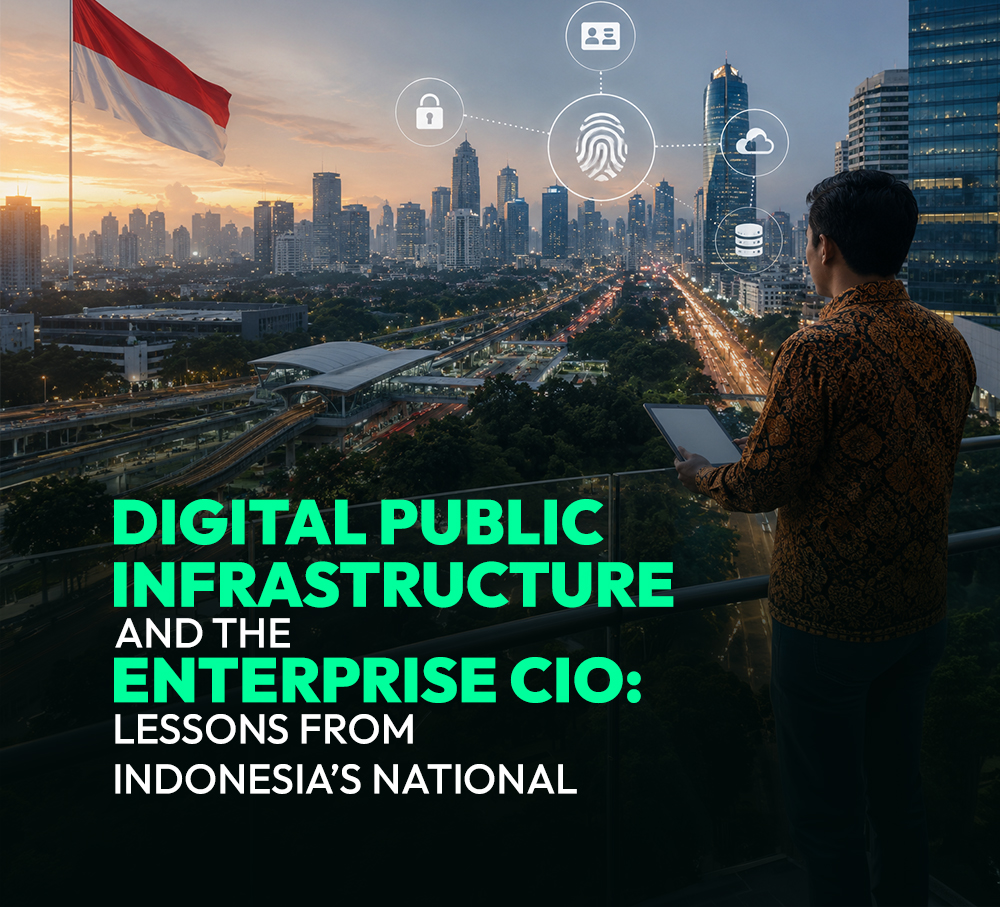
Indonesia is rebuilding its digital foundations at a national scale, and the lessons extend far beyond Southeast Asia. As Generative AI accelerates how enterprises process data, verify identity, and automate decisions, the public infrastructure connecting identity, payments, and data exchange matters just as much as the applications running on top of it.
For CIOs, Indonesia’s rollout is a live, unfinished test case in what works, what stalls, and what enterprise technology leaders should plan for before national digital rails become mandatory touchpoints for compliance, procurement, and citizen or customer-facing services across the region.
Understanding Digital Public Infrastructure in the Enterprise Context
What DPI Actually Covers
Digital Public Infrastructure is the shared digital layer beneath public and private services. It typically includes three components:
- Digital identity systems that verify individuals once, reliably, and reusably.
- Interoperable data exchange protocols that let institutions share verified information without duplicating it.
- Digital payment rails that function consistently across sectors and providers.
Unlike a single government application, DPI functions as connective tissue linking multiple institutions and services together.
The CIO’s Role in a DPI-Enabled Economy
Enterprise CIOs largely operate at the junction of public and private technology stacks. As national governments build identity and payment systems that citizens and businesses are expected to use, enterprises must decide how their own systems connect to this sovereign infrastructure without ceding control over internal data or compromising security architecture. That decision belongs on the enterprise roadmap early, not to be treated as a compliance afterthought once regulators mandate integration.
Inside Indonesia’s National DPI Rollout: A CIO-Level Review
The Core Pillars of Indonesia’s Digital Infrastructure Programme
Indonesia’s digital government strategy is built around three core pillars: digital identity, interoperable data exchange, and digital payments.
To advance this vision, INA Digital, Indonesia’s GovTech agency, was launched in May 2024 to unify public services that had previously been fragmented across an estimated 27,000 independently developed government applications. By consolidating these platforms, the initiative aims to simplify citizen access, reduce duplication, and create a more integrated digital public service ecosystem.
Milestones That Matter to Enterprise Technology Leaders
Within its first year, INA Digital moved from a pilot to an alpha version of integrated systems, including:
- An internal government portal connecting ministries
- A unified digital identity layer
- A citizen-facing service portal
Separately, the Digital Nusantara initiative, formalized through a Statement of Intent with UNDP in July 2025, is building a secure, interoperable backbone starting with social protection programmes.
Gaps and Friction Points Observed During Implementation
Progress has not been friction-free. Officials have acknowledged that identity, data exchange, and payment systems still function as separate assets rather than one shared resource. Ministries have historically resisted relinquishing control over data they consider their own, and technical regulation has often lagged behind political ambition, slowing the pace at which pilots scale into national systems.
Strategic Lessons for Enterprise CIOs from the Indonesian Model
Start with Interoperability, Not Integration
Indonesia’s leadership has repeatedly urged ministries to stop treating data as institutional property and to treat it instead as a shared resource. Enterprise CIOs should apply the same discipline internally, resolving data silos across business units, before attempting to connect with any external government rail.
Treat Identity Infrastructure as a Strategic Asset
A single, verified identity layer removes redundant verification steps entirely. Indonesia’s social assistance pilots already use biometric authentication linked to population registries rather than repeated document uploads. Enterprise identity systems deserve the same strategic investment as core financial or operational infrastructure, not to be treated as a routine IT utility.
Data Governance Cannot Be an Afterthought
Indonesia’s Satu Data Indonesia framework exists precisely because governance was not built in from the outset, forcing retrofits years later. CIOs building DPI-adjacent systems should establish clear governance rules, ownership boundaries, and audit protocols before scaling adoption, not after problems surface in production.
Workforce Readiness Determines DPI Adoption Speed
Officials leading Indonesia’s transformation consistently point to workforce mindset, not technology, as the hardest barrier to overcome. Enterprises pursuing similar integration should budget for structured change management with the same seriousness as they apply to infrastructure spending.
Building a DPI-Ready Enterprise: A Practical Roadmap for CIOs
Phase 1: Assessment and Readiness Mapping
Catalogue every internal system that touches identity, payments, or shared data. Identify redundant verification steps that could be eliminated through interoperable exchange with government-grade infrastructure, and document dependencies before committing budget.
Phase 2: Architecture and Governance Alignment
Set data ownership rules, access boundaries, and security protocols before any external integration begins. Align these policies with national frameworks so future connections do not require rework.
Phase 3: Pilot, Iterate, and Scale
Begin with focused, measurable pilots before moving toward enterprise-wide deployment. Use Generative AI to accelerate processes such as document verification and workflow automation, but only after governance frameworks, security controls, and interoperability foundations have been validated through real-world implementation.
Join digitalCIO to Influence Your Enterprise’s DPI Strategy
Indonesia’s Digital Public Infrastructure (DPI) strategy is still evolving, giving enterprise CIOs a critical opportunity to help shape its direction rather than adapt to decisions made later. digitalCIO Indonesia brings technology leaders together with policymakers, regulators, and practitioners responsible for building the country’s sovereign digital infrastructure, creating a platform for direct dialogue, practical insight, and collaborative problem-solving.
The summit features focused discussions on governance frameworks, integration roadmaps, and real-world interoperability challenges, alongside peer exchanges with CIOs navigating similar transformation priorities across industries. For technology leaders shaping their organization’s digital future, digitalCIO Indonesia offers timely access to the conversations and connections influencing Indonesia’s next phase of digital infrastructure development.
Register today.
Frequently Asked Questions
What is Digital Public Infrastructure?
Digital Public Infrastructure refers to digital systems for identity verification, secure data exchange, and payments that connect the public and private sectors.
Why does Indonesia’s rollout matter to CIOs?
Indonesia’s digital government strategy shows CIOs how national identity, data exchange, and payment policy affect integration and compliance planning.
What is INA Digital?
INA Digital is Indonesia’s GovTech agency, launched in 2024 to unify thousands of fragmented, independently built government applications and services.
How should CIOs prepare for DPI integration?
CIOs should first resolve internal data governance and interoperability gaps, establishing clear ownership rules before pursuing any external government connections.
What is the biggest implementation challenge?
Workforce mindset change remains the biggest implementation challenge in Indonesia’s rollout, proving harder to manage than the underlying technology itself.