

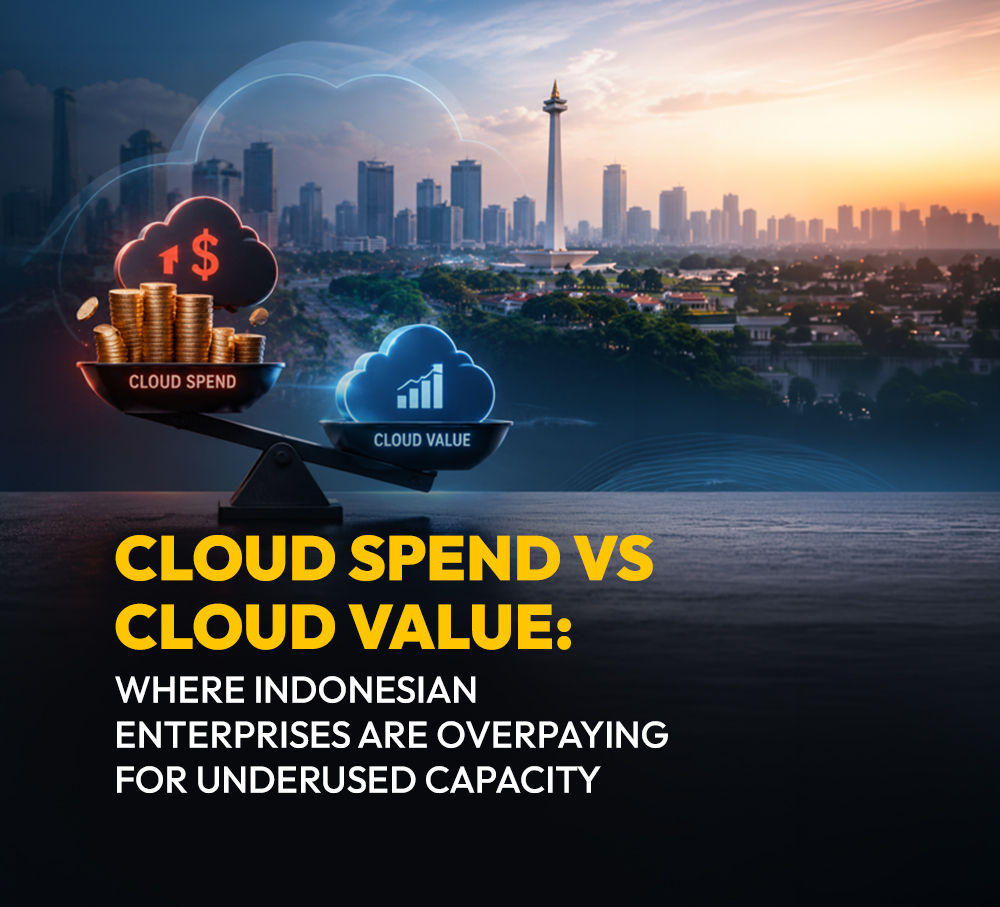
Indonesian enterprises pay for cloud capacity they don’t use, and most finance leaders lack visibility into how much they’re overpaying. Cloud budgets have grown steadily across banking, retail, and manufacturing, but the business value generated from that spend hasn’t kept pace. Idle compute, oversized storage tiers, and unused reserved instances accumulate quietly across billing cycles.
This disconnect between what enterprises pay for and what they actually consume is why cloud cost optimization in Indonesia has moved from an IT concern to a standing item on the executive agenda.
The Widening Gap Between Cloud Spend and Cloud Value
Why Cloud Bills Keep Rising Faster Than Actual Usage
Cloud infrastructure is designed to scale on demand, but most enterprises provision for peak load and rarely scale back down. Development and testing environments often run continuously, even though they’re needed only during business hours. Autoscaling policies are set once at deployment and left unreviewed as workloads evolve.
Each of these decisions is small individually, but when compounded across hundreds of workloads, they explain why invoices grow faster than genuine business usage.
The Illusion of Cost Control Without Value Measurement
Tracking total cloud spend is not the same as controlling it. A budget that stays flat year over year can still conceal significant waste if underlying usage patterns have shifted. Enterprises without cloud cost management strategies that link spend to specific business outcomes often mistake a stable invoice for efficiency, delaying the discovery of underused capacity.
Indonesia’s Cloud Market Momentum and Its Hidden Cost
A Market Expanding Faster Than Governance Can Keep Up
Indonesia’s cloud market is projected to grow from approximately $2.8 billion in 2026 to $5.5 billion by 2031. Hyperscaler investment, government digital transformation mandates, and accelerating enterprise adoption of cloud computing across financial services, healthcare, and logistics drive this expansion. But governance and FinOps maturity haven’t kept pace — procurement approvals for new workloads are running well ahead of reviews of what’s already deployed.
Where Indonesian Enterprises Quietly Overspend
Enterprises operating across AWS, Azure, Alibaba Cloud, and domestic providers frequently lose cost visibility the moment infrastructure spans more than one platform. Effective multi-cloud management in Indonesia therefore depends on centralised tagging, consolidated billing, and clearly assigned ownership — three capabilities that remain underdeveloped across most Indonesian enterprise environments today.
The Real Business Impact of Underused Cloud Capacity
Beyond the Invoice Margin: Trust and Strategic Agility
According to Flexera’s State of the Cloud Report, organisations globally waste an estimated 27% of cloud spend annually, and Indonesian enterprises are no exception. Every Rupiah locked into idle infrastructure is capital unavailable for product innovation, market expansion, or customer experience investment, the areas where competitive advantage is actually built.
The Trust Gap Between IT and Finance
Unpredictable cloud invoices erode cross-departmental trust. Finance teams begin scrutinising every technology request, including justified ones, while IT leaders feel constrained and under-resourced. Over time, this dynamic turns budget planning into a recurring point of friction rather than a shared strategic exercise between finance and technology leadership.
Closing the Gap From Cloud Spend to Cloud Value
Building a FinOps-First Culture
Closing this gap requires treating cloud spend as a joint financial and engineering responsibility, not a purely technical line item. Enterprises that establish dedicated FinOps functions, enforce quarterly rightsizing reviews, and audit reserved capacity typically recover a meaningful share of wasted spend. Durable cloud cost management strategies combine automated monitoring with structured human review, since dashboards alone rarely change spending behaviour.
Making Cloud Accountability a Shared Responsibility
Cost accountability works best when it sits with the teams actually consuming resources, not solely within a central IT function. Tagging workloads by department, publishing regular usage reports, and tying budgets to measurable outcomes reinforce this. Strong multi-cloud management practices in Indonesia ensure this accountability holds across every provider, not just the primary one.
Key Takeaways for Indonesian Technology Leaders
The core issue is not that Cloud computing is inherently costly. It is that usage is rarely measured against the value it delivers.
- Right-size compute and storage on a recurring schedule, not a one-time basis
- Establish a FinOps function with joint IT and finance representation
- Standardise tagging and billing visibility across every cloud provider in use
- Tie infrastructure budgets to measurable business outcomes, not raw consumption
Enterprises that adopt these practices consistently reduce wasted spend within a few operating quarters.
Reserve Your Seat at digitalCIO Indonesia 2026, the Nation’s Leading Technology Leadership Summit
The cost-value gap outlined above will be a central focal point at digitalCIO Indonesia, convening on 11 November at The Ritz-Carlton Jakarta, Pacific Place. Now in its third edition, this exclusive, closed-door summit gathers over 350 elite CIOs, CTOs, CDOs, and enterprise technology pioneers from the archipelago’s most influential public and private organizations. Together, they will address the critical intersections of cybersecurity resilience, sovereign cloud migration, real-time AI scaling, and sustainable digital transformation strategy.
For leadership teams tasked with balancing volatile cloud budgets against strict national governance mandates, the summit offers an unparalleled benchmarking ground alongside peers navigating identical commercial pressures. Apply to reserve your seat today and join the definitive room shaping Indonesia’s corporate technology agenda.
Frequently Asked Questions
What causes cloud overspending in Indonesian enterprises?
Overspending mainly comes from idle instances, oversized resources, and unused reserved capacity left unchecked without routine monitoring and rightsizing reviews.
How should enterprises approach cloud cost optimization in Indonesia?
Start by auditing current usage, eliminating idle resources, rightsizing workloads, and assigning clear cost ownership across every business department.
Is multi-cloud inherently more expensive than single-cloud infrastructure?
No, multi-cloud only costs more when governance is weak. Centralised tagging and monitoring keep multi-cloud spend predictable and controllable.
What role does FinOps play in reducing cloud waste?
FinOps aligns engineering, finance, and business teams so they evaluate cost and value together, significantly reducing unnoticed overspending across departments.
How frequently should enterprises review cloud usage?
Quarterly reviews suit most enterprises, while fast-scaling organisations benefit from monthly checks that catch waste before it accumulates further.