

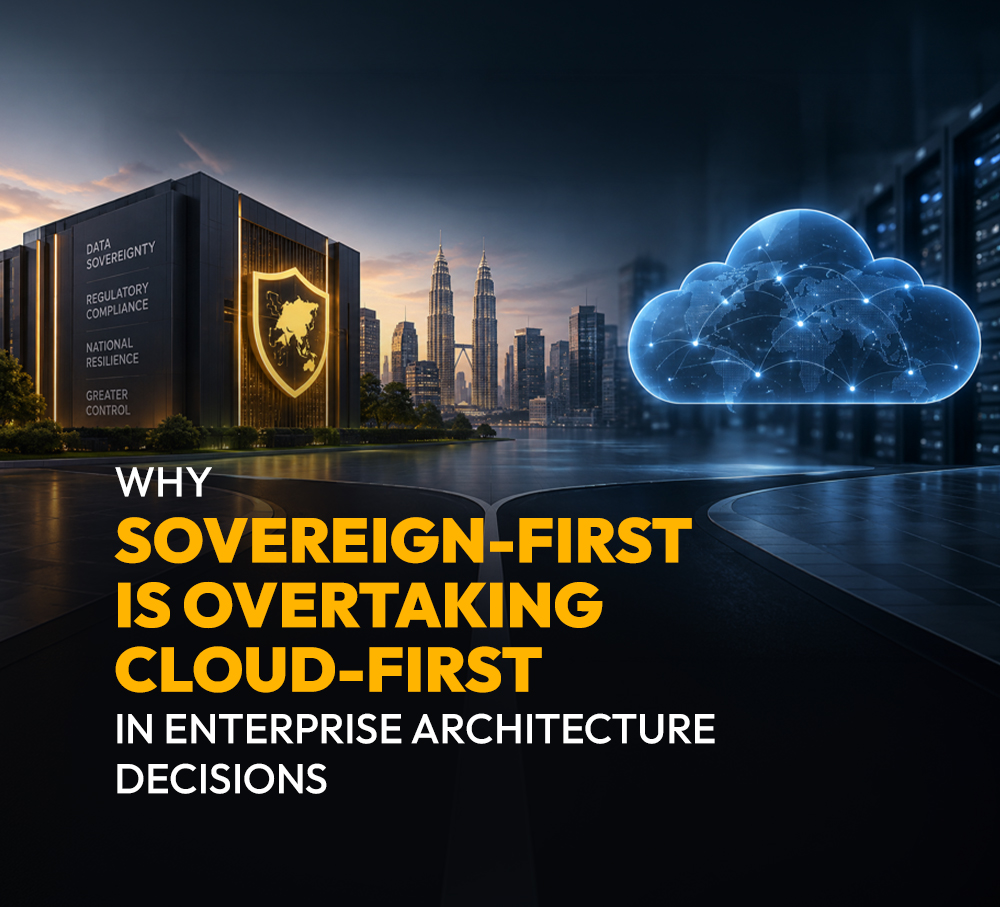
Sovereign-first architecture is a design approach that prioritises absolute data sovereignty and operational control over deployment speed and upfront cost. For most of the last decade, cloud-first architecture held that position instead, chosen for scale, elasticity, and lower upfront spending. Boards are now questioning that order.
Governments across Europe, West Asia, and the Asia Pacific are tightening cross-border data transfer rules, and executives increasingly weigh foreign jurisdiction exposure against short-term convenience. Few enterprises are abandoning the cloud outright. Most are changing what comes first: whether control leads cost, or cost drives the roadmap.
What Sovereign-First Architecture Actually Means
Sovereign-first architecture means designing IT systems so that jurisdiction—not price or performance—decides where a workload lives. Infrastructure, encryption keys, and administrative access sit under a legal authority the enterprise fully understands, rather than defaulting to the cheapest available compute.
For a board, this translates into three requirements. Regulated workloads run on sovereign infrastructure based in the country where the underlying data subject resides. Key management stays local, even when the software layer runs on a foreign vendor’s platform, and providers must prove auditability to a domestic regulator.
None of this rules out public cloud services. Sovereignty is decided before deployment, not after a breach.
Why Cloud-First Strategies Are Losing Ground
Worldwide sovereign cloud infrastructure spending is projected to reach $80 Billion in 2026, a 35.6% increase from 2025, according to Gartner. That growth reflects a change in how executives weigh risk, not a loss of confidence in cloud computing itself.
Three forces explain the shift. Geopolitical tension has made heavy reliance on a handful of foreign hyperscalers feel riskier to both boards and regulators. Local and industry-specific rules now demand proof of actual control, and hidden costs—such as data transfer fees, exit penalties, compliance fixes—are outweighing the early savings cloud-first once promised.
Gartner projects that around 20% of existing global workloads will move from public cloud to local providers this year, a scale of movement boards can no longer treat as a niche concern.
The Business Case Driving The Shift
For most C-suite leaders, sovereignty is now a revenue question, not a compliance footnote. Market access often depends on it directly; i.e., several governments require proof of local data control before granting public sector or regulated contracts, excluding non-compliant vendors outright, no matter how competitive their price.
Risk transfer follows a similar logic. Keeping sensitive workloads under domestic legal authority reduces exposure to foreign subpoenas, sanctions, and sudden platform access restrictions that a contract alone cannot prevent. Cost predictability matters too, since local infrastructure partnerships tend to carry more transparent pricing than multi-region hyperscaler agreements with variable egress and transfer fees.
Kyndryl’s 2025 Cloud Readiness Report found that nearly 75% of business leaders were concerned about the geopolitical risk of storing data in global cloud environments — which serves as evidence that sovereignty must now sit on the board agenda.
Key Considerations For Enterprise Leaders
Shifting to sovereign-first does not require rebuilding existing enterprise architecture from the ground up. It requires auditing what already exists against jurisdictional risk, then adjusting selectively where exposure is highest.
Four questions deserve board-level attention.
- Which data sets are actually regulated or contractually restricted, since not every workload needs sovereign hosting?
- Can vendors document exactly where data physically resides, who can access it, and under what legal process?
- Do contracts specify data portability terms up front, so an exit does not become a multi-year project?
- Does the organisation have the in-house or regional staff needed to manage sovereign deployments, since this changes hiring and vendor oversight?
Gartner’s Market Guide frames the trade-off plainly: higher degrees of sovereignty gained through local control usually comes with reduced platform flexibility, and leaders should treat that as a necessary cost.
Regional Outlook: Sovereignty Across Asia Pacific and Indonesia
Indonesia’s Personal Data Protection Law—in force since October 2022 with a transition period that closed in October 2024—focuses on protection standards rather than physical location. However, several sectors still have hard requirements.
Health data must be stored within Indonesian data centres under Government Regulation 28 of 2024. Non-bank financial institutions face similar obligations under OJK Regulation 4 of 2021, and public system operators still answer to GR 71 of 2019 for strategic data categories. Mature Asia Pacific markets, including Indonesia, are projected to be among the fastest-growing regions for sovereign cloud spending in 2026, per Gartner.
Indonesia’s layered data residency regulations mean enterprises running cloud computing and on-premises systems together cannot rely on a single global compliance posture. A workload compliant elsewhere may still need local hosting once it touches Indonesian data.
Attend digitalCIO Indonesia and Build a Sovereign-First Enterprise Strategy
The third edition of digitalCIO Indonesia, taking place on 11 November 2026 at The Ritz-Carlton Jakarta, Pacific Place, is built around the pressing question of how organisations need to architect systems for Indonesia’s actual regulatory environment. Sessions bring together technology leaders, regulators, and infrastructure providers navigating the country’s layered data residency rules.
Through interactive, peer-led sessions and strategic panels, attendees leave with practical guidance on deploying sovereign infrastructure and classifying regulated workloads, without sacrificing the agility that makes cloud adoption attractive, further ensuring that digital modernization moves forward in tandem with compliance.
For CEOs, CFOs, and CIOs, the summit functions as a high-value platform to align digital investments directly with local governance realities, protecting the enterprise from geopolitical risks and operational bottlenecks while accelerating cross-sector market growth.
Frequently Asked Questions
What is the difference between sovereign-first and cloud-first architecture?
Cloud-first prioritises deployment speed and scale above everything else. Sovereign-first starts with legal jurisdiction, then adds cloud services where it fits.
Does Indonesia require all data to stay in-country?
The PDP Law skips localisation, though data residency requirements in Indonesia apply strictly to health and finance.
Is sovereign-first only relevant to regulated industries?
No. Cross-border data draws regulatory scrutiny even outside heavily regulated sectors, since most enterprises also handle foreign-linked data.
Does going sovereign mean abandoning the public cloud entirely?
No. Most enterprises run hybrid models, keeping regulated workloads fully local while lighter, non-sensitive workloads run on public cloud.