

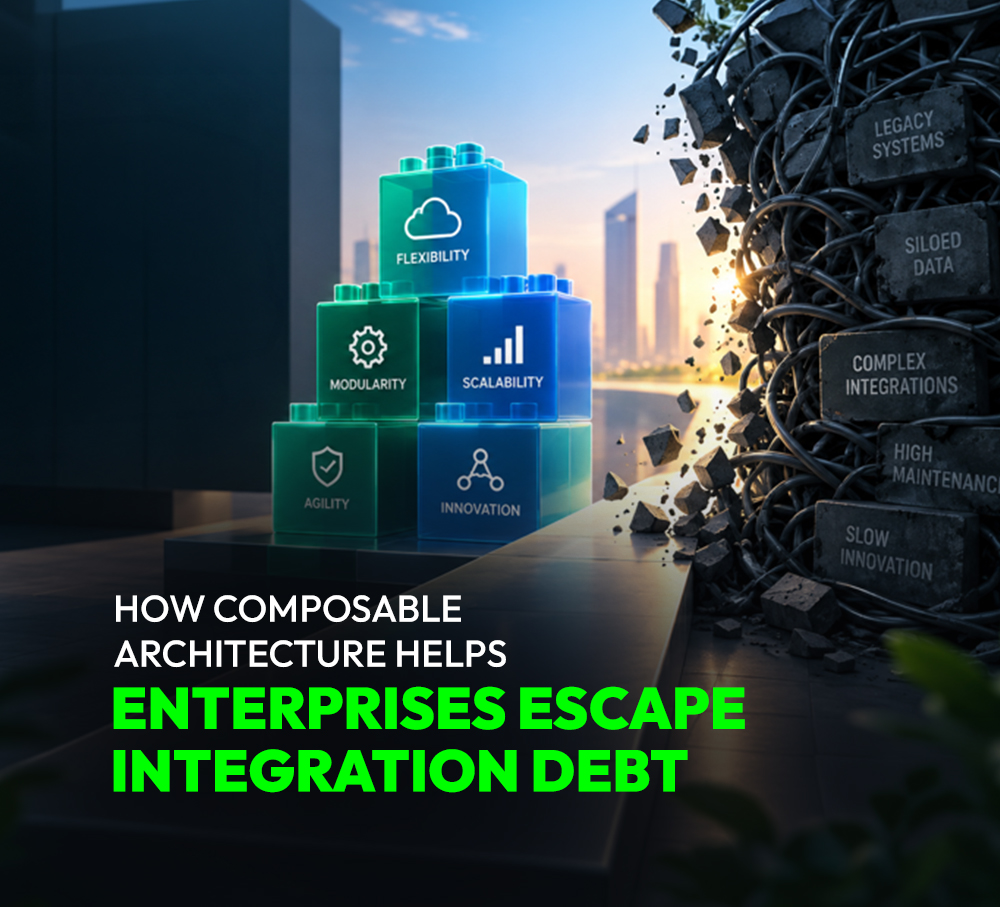
Integration debt is the single largest hidden cost slowing enterprise digital transformation today. Every system bolted onto a legacy stack without a common architecture adds a connection that must be maintained, secured, and eventually rebuilt.
For a growing composable architecture enterprise in Indonesia, this cost shows up as delayed product launches, rising IT spend, and boards asking why transformation budgets keep growing without matching output. Banking, telecommunications, and government platforms all face the same pressure, since customer expectations move faster than legacy systems can adapt. The solution isn’t another patch on the same foundation. It is a structural shift in how enterprise systems are designed, connected, and governed.
Understanding Integration Debt in Today’s Enterprise Landscape
Integration debt is the accumulated cost of connecting systems through custom, non-standard code instead of shared interfaces. Each workaround solves an immediate problem while quietly making the next change more expensive and slower to deliver.
For leadership teams, this debt rarely appears as a clean line item on a budget report. It shows up as slower time to market, unpredictable IT spend, and rising operational risk across the business. A new product launch that should take weeks stretches into quarters because integrating one additional vendor requires custom engineering work.
Compliance and risk teams lose visibility into how data actually moves once connections are undocumented and inconsistently maintained. Indonesian enterprises operating in banking, telecommunications, and government services feel this pressure most acutely, since regulatory timelines and citizen-facing platforms leave little room for delay. Left unmanaged, integration debt compounds year after year, and every future initiative inherits the cost of past shortcuts.
What Composable Architecture Means for Enterprise IT
Composable architecture is a design approach that replaces large, tightly coupled systems with independent components that can be assembled, replaced, and scaled on their own. Instead of one platform handling every function, capabilities such as payments, identity verification, or customer onboarding operate as separate services connected through clearly defined interfaces.
Three principles govern this model:
- Modularity ensures any component can change without disrupting the rest of the system
- Autonomy allows teams to build, test, and release independently, without waiting on a shared release cycle across departments
- Orchestration ensures these independent components still function together as one coherent enterprise, rather than a loose collection of disconnected tools competing for attention.
For enterprise architecture leaders, this reframes planning around business capabilities rather than individual applications, giving the organisation a structure that adapts to change instead of resisting it quarter after quarter.
How Composable Architecture Helps Enterprises Escape Integration Debt
Breaking Down Legacy Silos
Composable architecture exposes data and business logic trapped inside legacy applications through standardised interfaces that other systems can safely consume. This is the foundation of effective legacy system modernisation, since capabilities can be extended and reused without rebuilding entire platforms from scratch or pausing daily operations for months at a time.
Enabling Faster and Safer Integration
API-first design strategies build interfaces before implementation, so every new service is designed to connect from day one rather than retrofitted later. This shortens integration timelines from months to weeks and significantly reduces the risk of disrupting live systems when new tools or partners are introduced.
Reducing Long-Term Technical Debt
Independent components can be retired and replaced individually rather than through disruptive, all-at-once migrations that stall other projects. This keeps modernisation a continuous process instead of forcing a costly, high-risk rebuild every few years to stay current with market demands.
Business Value and Long-Term Benefits for Enterprise Leaders
Composability changes how fast a business can respond to regulation, competition, and shifting customer demand. Recent industry research shows most enterprise technology leaders report that composable investments exceeded ROI expectations, with faster time-to-market and stronger organisational agility cited as the leading gains.
For enterprise leaders, the return on this shift shows up in five distinct areas that matter directly to the board:
- Faster product launches, since new capabilities are assembled from existing components rather than built from scratch each time.
- Lower integration costs over the long run, as standard interfaces reduce dependence on custom development and specialised vendor support.
- Greater system resilience, since one component failing does not take down the entire enterprise platform or customer experience.
- Vendor flexibility, allowing underperforming tools to be replaced quickly without triggering a full platform rebuild or lengthy procurement cycle.
- Stronger audit readiness, since modular systems make data flows easier to trace, document, and defend during regulatory review.
For a composable architecture enterprise in Indonesia, these gains translate directly into competitive position. Digital banking, telecommunications, and public sector platforms all compete on speed and reliability. Enterprise architecture teams that demonstrate this return earn a stronger seat at the strategy table. Organisations still running on rigid, coupled systems will steadily lose ground to competitors who are able to adapt.
Join digitalCIO Indonesia and Build a Truly Composable Enterprise
Reducing integration debt starts with a fundamental shift in how leadership approaches architectural decisions. digitalCIO Indonesia, taking place on 11 November 2026 at The Ritz-Carlton Jakarta, Pacific Place, brings together forward-thinking CIOs, CTOs, and enterprise architects to confront this challenge directly.
The curated agenda covers API-first design within major Indonesian enterprise programmes, modern governance models, and practical legacy modernization roadmaps drawn directly from complex, regional deployments.
Rather than abstract theories or generic vendor pitches, attendees leave with peer-tested frameworks ready for immediate execution within their own organizations. For leaders determined to eliminate integration debt and engineer a genuinely resilient, future-ready enterprise, this is where that critical work begins in earnest!
Frequently Asked Questions
What is integration debt in enterprise IT?
Integration debt is the accumulated cost of custom, non-standard connections between systems, built up without any unifying architecture in place.
How does composable architecture reduce integration debt?
It replaces rigid, custom connections with modular components using standard interfaces, allowing systems to change independently without triggering full rebuilds.
Why is API-first design important for enterprises?
It ensures new systems are built to connect from day one, shortening integration timelines and lowering overall deployment risk.
Does composable architecture support the modernisation of older systems?
Yes, it allows gradual, low-risk replacement of outdated components without disrupting the broader enterprise platform or ongoing daily business operations.
Who should attend digitalCIO Indonesia?
CIOs, CTOs, and enterprise architects focused on reducing integration complexity while building resilient, future-ready digital infrastructure across their organisations.