
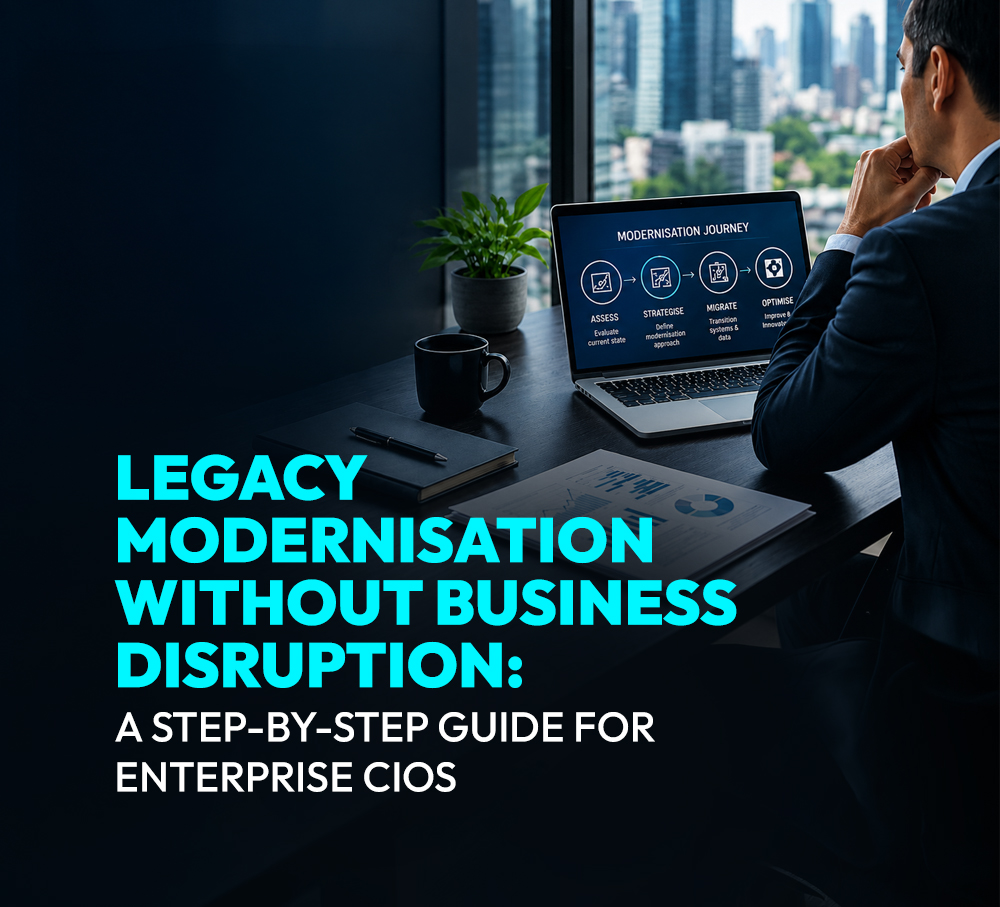
Legacy system modernisation is the process of upgrading or replacing outdated enterprise software to meet current business, security, and performance needs without disrupting operations. For enterprise CIOs, this has moved from a technical backlog item to a board-level priority, because ageing infrastructure now actively slows business growth. Systems built decades ago were never designed for cloud scale, real-time data, or the security demands enterprises now face. Yet enterprises cannot risk downtime, data loss or disrupted service while modernising. This guide sets out a practical, step-by-step approach CIOs can use to modernise legacy systems while keeping the business running.
Understanding the Real Cost of Legacy Systems
Hidden Maintenance and Technical Debt
Legacy platforms rarely show their true cost on a balance sheet. Deloitte’s 2026 Global Technology Leadership Study found that technical debt now accounts for between 21–40% of total IT spending, money that would otherwise fund new capabilities. Engineering teams routinely spend close to half their working week patching and firefighting instead of building. This has moved modernisation from an IT concern to a boardroom one.
Security and Compliance Exposure
Outdated systems often lack encryption standards, audit trails, and modern authentication, leaving them exposed. A single breach can cost several million dollars, and regulatory penalties under frameworks such as GDPR add further risk.
Slower Innovation and Weaker Customer Experience
When engineering capacity is consumed by maintenance, product teams cannot respond to market demand, and customers feel the gap through slower service and outdated digital experiences.
Building a Business-Aligned Modernisation Roadmap
Assessing Current Systems and Business Priorities
Before any technical decision is made, CIOs need a clear inventory of applications, dependencies, and business value. Mapping this against the organisation’s enterprise architecture reveals which systems are genuinely critical, which quietly duplicate effort, and which can be retired without any real business impact.
Setting Clear and Measurable Objectives
Every modernisation initiative should tie back to a business outcome, whether that is faster time to market, lower operating cost, improved resilience, or better customer retention. Vague ambitions rarely survive budget cycles or leadership scrutiny.
Sequencing the Roadmap for Minimum Disruption
Rather than attempting a single large migration, a phased digital transformation roadmap prioritises high-risk, high-cost systems first, while leaving stable, low-risk applications untouched and running until later phases. This sequencing protects daily operations while still delivering measurable progress every quarter.
Choosing the Right Modernisation Approach
Rehosting and Replatforming
Rehosting moves an application to modern infrastructure with minimal code change, offering a fast, lower-risk starting point for teams working under time pressure or tight budgets. Replatforming goes a step further, adjusting the application to use cloud-native features without a full rebuild.
Refactoring and Rearchitecting
Refactoring restructures the underlying code and architecture so systems can scale properly and integrate with modern tools. This is where genuine app modernisation delivers long-term value, rather than simply relocating old problems onto new infrastructure.
The Strangler Pattern for Gradual Replacement
Popularised by Martin Fowler, the strangler pattern gradually replaces components of a legacy system with new services. In contrast, the old system continues to run until it can finally be retired safely. Many enterprises favour this route because it avoids a risky single cutover, allowing app modernisation to proceed incrementally with continuous validation at every stage.
Managing Risk and Ensuring Zero Disruption
Parallel Running and Phased Cutover
Running old and new systems side by side allows teams to compare outputs under real conditions and catch discrepancies before customers or business users ever notice a difference in service. Cutover then happens in small, controlled batches rather than as a single high-stakes weekend event.
Data Migration and Integrity Checks
Data must be validated at every stage of migration, with reconciliation checks confirming that records match exactly between the legacy and modern environment before any legacy component is switched off for good.
Rollback Planning and Contingency Measures
Every phase needs a documented rollback path, tested in advance rather than improvised under pressure. If a cutover introduces unexpected errors, teams should be able to revert quickly, minimising impact on customers, revenue, and daily operations.
Governance, Change Management, and Stakeholder Alignment
Executive Sponsorship and Cross-Functional Ownership
Modernisation succeeds when it has visible executive backing and shared ownership across IT, finance, and operations, not just the technology function. Aligning the initiative with the wider enterprise architecture ensures that every department works towards the same outcome.
Employee Training and Communication
Staff need early, honest communication about what is changing and why, along with hands-on training on new systems well before go-live.
Vendor and Partner Coordination
Third-party vendors must be briefed early, since integrations and support contracts often need renegotiation as the underlying systems change.
Join digitalCIO Indonesia and Shape Your Modernisation Roadmap
digitalCIO Indonesia brings together enterprise technology leaders to address the above stated challenges directly — from planning complex migrations and securing executive alignment to managing vendor relationships and demonstrating progress to senior leadership. The forum gives CIOs and technology executives a space to share lessons from real transformation programmes, focusing on what has worked in practice rather than relying on assumptions or vendor-led narratives.
Taking place on 11 November 2026 at The Ritz-Carlton Jakarta, Pacific Place, the summit offers organisations an opportunity to learn from peers who have navigated similar digital transformation efforts within comparable budget, operational, and compliance constraints. Attendees leave with practical approaches, clearer perspectives on technology decisions, and a stronger network of leaders facing similar challenges across the region.
Frequently Asked Questions
What is legacy system modernisation?
This process involves upgrading or replacing outdated enterprise software to fully meet current business, security, performance, and compliance requirements.
How long does modernisation typically take?
Timelines vary by scope, but phased enterprise modernisation programmes typically run 12–24 months across sequenced, validated release stages.
Is the strangler pattern always the best approach?
No, the strangler pattern suits large, complex, high-risk systems best. Simpler, lower-risk applications often need only rehosting or replatforming instead.
How is disruption prevented during migration?
Disruption is prevented through parallel running, rigorous data integrity checks, phased cutovers in small batches, and a tested rollback plan.
Who should own the modernisation roadmap?
Ownership should sit with the CIO, supported by active sponsorship from finance and business leaders who share accountability for results.