

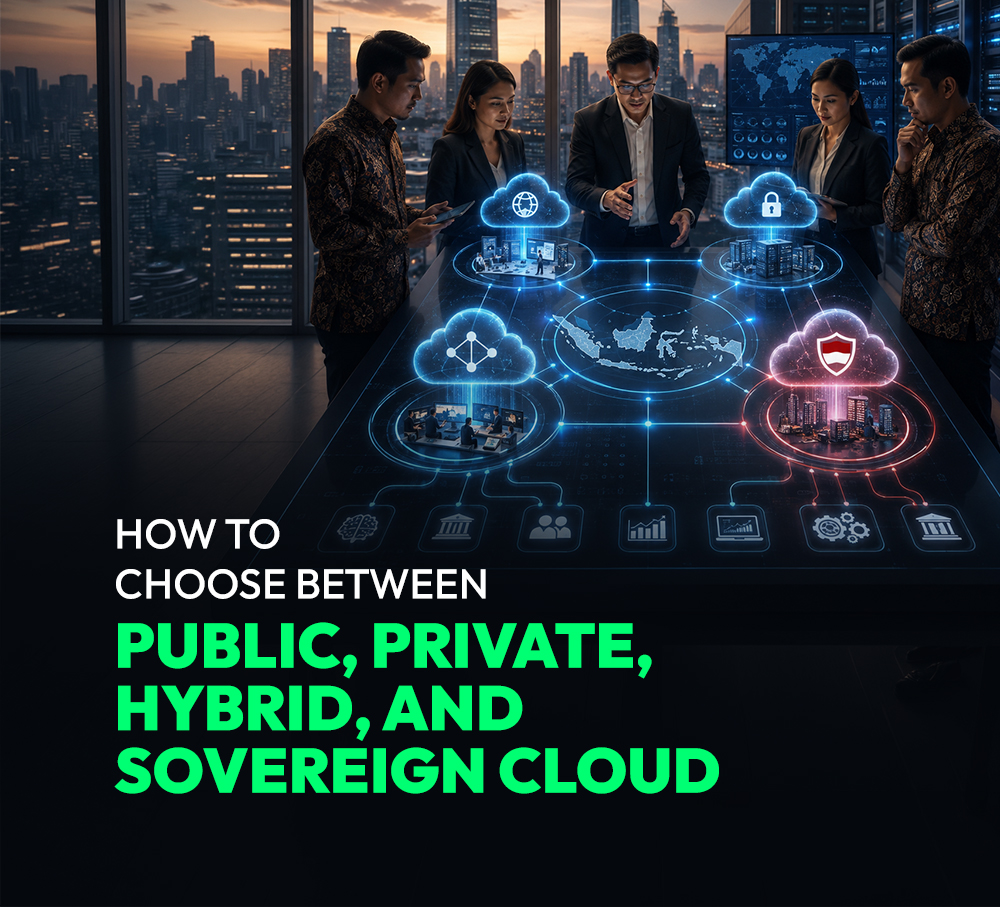
Enterprise leaders are no longer debating whether to adopt cloud computing. The focus has shifted to determining which deployment model — public, private, hybrid, or sovereign cloud — aligns best with their risk profile, regulatory obligations, operational requirements, and long-term growth strategy. Each model addresses different business needs, and selecting the wrong approach can lead to compliance challenges, higher operating costs, reduced flexibility, and slow innovation.
For CIOs across Indonesia, this decision carries additional significance as data protection rules become increasingly stringent and investment in cloud infrastructure continues to grow.
This guide explains each deployment model in practical terms and outlines the key factors that should drive the decision-making process so that technology leaders can choose with confidence.
Understanding Public Cloud
Public cloud delivers computing resources, servers, storage, and networking over the internet through providers such as AWS, Microsoft Azure, or Google Cloud. Multiple organizations share the same underlying infrastructure, though data stays logically separated between accounts.
Its biggest advantage is elasticity: teams can scale capacity up or down within minutes, without buying or maintaining hardware. Costs follow a pay-as-you-go model, which suits startups and fast-growing companies that cannot precisely forecast demand. It also gives faster access to advanced tools, including machine learning platforms, without heavy upfront investment. The tradeoff is reduced control over where data physically resides, a real concern for organizations bound by strict data residency rules.
Understanding Private Cloud
Private cloud dedicates infrastructure to a single organization, hosted either on premises or by a third party in a segregated environment. This isolation gives IT teams direct control over security configurations, compliance controls, and performance tuning. Banks, insurers, and government bodies often favor private cloud because it limits exposure to multi-tenant risks and simplifies audit trails. The trade-off is cost. Building, operating, and maintaining dedicated infrastructure requires substantial capital investment, ongoing maintenance, and specialized technical expertise. Scaling is also slower than in the public cloud, since additional capacity usually requires procuring new hardware. Private cloud suits organizations handling highly sensitive data or workloads under heavy regulatory scrutiny, where shared infrastructure is unacceptable risk.
Understanding Hybrid Cloud
Hybrid cloud combines public and private environments, connected through orchestration that lets data and applications move between them as needed. Organizations typically keep sensitive workloads on private infrastructure while running customer-facing applications or seasonal traffic spikes on public clouds. This approach gives IT leaders flexibility without forcing an all-or-nothing commitment to one model. A well-designed hybrid cloud strategy lets a business modernize gradually, test new capabilities in public environments, and retain control where regulation or risk demands it. It also supports disaster recovery, since workloads can fail over between environments if one is disrupted. The main challenge lies in integration. Networking, identity management, and security policies must operate consistently across both cloud environments, requiring mature governance, well-defined processes, and skilled technical teams.
Understanding Sovereign Cloud
A sovereign cloud is infrastructure built and governed within a specific country’s legal jurisdiction, ensuring data never leaves that jurisdiction and stays subject only to local law. It emerged as governments and regulated industries pushed back against foreign data access laws that could override local privacy protections. Indonesia illustrates why this matters. Its Personal Data Protection Law, the country’s first comprehensive framework for personal data, became fully binding once the transition period ended, with a dedicated enforcement agency expected in 2026. Banking regulators have gone further, requiring commercial banks to keep data centers and recovery sites within Indonesian territory. For regulated sectors, sovereign cloud offerings in Indonesia directly address these obligations, keeping data onshore while still delivering modern cloud capabilities.
Key Factors for CIOs to Evaluate
Choosing the right model requires weighing several interconnected factors rather than following a generic checklist.
- Regulatory and data residency requirements: Understand where data must legally reside and which authorities can request access to it
- Workload sensitivity and risk tolerance: Classify data by sensitivity before deciding which environment each workload belongs in
- Budget, scalability, and long-term growth: Balance upfront capital costs against ongoing operating expenses and future scaling needs
- Vendor dependency and exit strategy: Design for flexibility by avoiding architectures that make switching providers or migrating workloads unnecessarily difficult or costly
- Talent readiness and operational maturity: Confirm that internal teams can actually manage the governance complexity that each model introduces day-to-day
These factors rarely point to a single clear answer, which is why many CIOs end up building hybrid infrastructure that blends models based on workload rather than committing entirely to one.
Where Indonesia’s Technology Leaders Shape These Decisions
Indonesia’s digital economy is expanding fast, and with that growth comes tighter scrutiny on how data is stored, processed, and protected. Financial services, healthcare, and government sectors face the strictest residency obligations, while consumer technology firms weigh cost efficiency against emerging compliance requirements. CIOs across the country are increasingly building hybrid infrastructure that keeps regulated data onshore while using public cloud for innovation and scale.
A practical hybrid cloud strategy has become less of an option and more of a baseline expectation. These decisions rarely occur in isolation; they require ongoing dialogue among technology leaders, regulators, and infrastructure providers as they navigate a fast-evolving landscape.
Attend digitalCIO Indonesia and Make Informed Cloud Decisions
Cloud strategy decisions have long-term implications for cost, compliance, resilience, and operational flexibility, making practical peer insights especially valuable. digitalCIO Indonesia brings together technology leaders who are navigating these decisions firsthand, from data residency and cloud governance to vendor selection and infrastructure planning. Discussions draw on real deployment experience across public, private, hybrid, and sovereign cloud environments, providing practical lessons grounded in operational realities.
Taking place on 11 November 2026 at The Ritz-Carlton Jakarta, Pacific Place, the summit offers CIOs and technology executives an opportunity to learn from peers who have already addressed similar infrastructure, regulatory, and business challenges. Attendees leave with practical frameworks, implementation insights, and a stronger understanding of how different cloud strategies perform in real enterprise environments.
Frequently Asked Questions
What is the main difference between public and private cloud?
Public cloud shares infrastructure among many tenants, while private cloud dedicates infrastructure to a single organization for tighter control and compliance.
Why do organizations choose hybrid cloud over a single model?
Hybrid cloud balances flexibility and control, allowing sensitive workloads to remain private while other, lower-risk operations scale publicly during demand spikes.
What makes sovereign cloud different from private cloud?
Sovereign cloud guarantees that data remains within a defined legal jurisdiction, addressing residency laws that a private cloud alone cannot meet.
Is hybrid cloud more expensive than public cloud?
Hybrid cloud often costs more upfront due to integration and governance overhead, but it usually reduces long-term risk exposure.
Who needs sovereign cloud the most?
Regulated sectors need sovereign cloud the most, especially banking, healthcare, and government bodies handling sensitive citizen data under strict laws.