

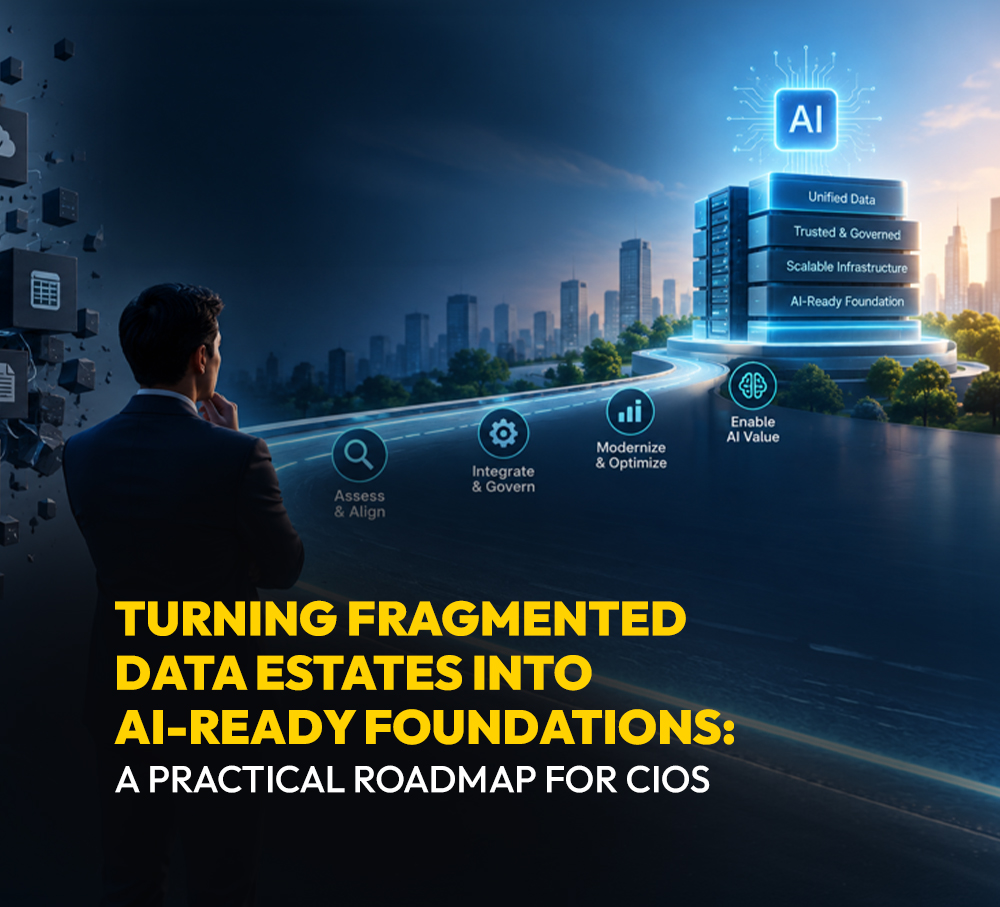
An AI-ready data estate is one where information stays accurate, consistently defined, and instantly accessible across every business system, not scattered across spreadsheets, legacy ERPs, and regional databases. For most Indonesian enterprises, that description still doesn’t match reality. As artificial intelligence moves from pilot projects to core operations, this gap becomes a direct constraint on growth and competitive positioning.
Building an AI-ready enterprise in Indonesia requires more than new algorithms; it requires a data foundation trustworthy enough for executives to act on without hesitation.
The Hidden Cost of Fragmented Data Estates
Where Fragmentation Begins
Fragmentation builds gradually. Departments buy their own tools, regional offices set up local databases, and mergers bring in systems that were never designed to connect. Soon finance reports one revenue figure while sales reports a different number for the same quarter — not because either team made an error, but because each measured the same event using different system definitions.
The Business Impact
The cost shows up as slower reporting, duplicated customer records, and decisions based on outdated numbers — especially in fast-growing, regulated sectors. Analysts spend more time reconciling spreadsheets than interpreting them. Weak data governance in Indonesia is rarely a single failure; it is the accumulated effect of quiet, department-by-department drift that no single leader was ever held accountable for fixing.
Why Artificial Intelligence Fails Without a Unified Foundation
Common Failure Points
AI models learn from patterns in data, so inconsistent or duplicated inputs produce inconsistent, untrustworthy outputs, no matter how sophisticated the model is. A model trained on three versions of a customer database returns three versions of what could be the right output, and an executive cannot act confidently on any of them.
Common failure points include duplicate customer identifiers, historical data left uncleaned before migration, and access rules that vary department by department rather than following one policy. Building a credible enterprise data strategy that CIO teams can stand behind starts with closing these gaps before any model reaches production.
What the Research Shows
IDC’s FutureScape 2026 analysis identifies a consistent pattern across the Asia-Pacific: enterprises unable to connect AI outputs to core business systems are already falling behind competitors that treated data readiness as a prerequisite, not an afterthought bolted on once a project stalls.
Core Building Blocks of an AI-Ready Data Estate
Governance and Ownership
Every dataset needs a named, accountable owner responsible for its accuracy, access rules, and retention period. Without ownership, quality issues get noticed but rarely resolved.
A Unified Semantic Layer
Departments often use identical terms to mean different things, and this mismatch is one of the most common blind spots in enterprise reporting. A shared semantic layer defines each business term once, such as an active customer or a completed transaction, so every report and model draws from one consistent source.
Scalable and Secure Infrastructure
None of this holds without the right technical base. A well-planned data platform architecture in Indonesia must handle rising data volumes, support real-time access for AI workloads, and meet local data protection requirements without slowing delivery. Together, these three elements convert scattered databases into a foundation AI systems can reliably use.
A Practical Roadmap CIOs Can Follow
Step 1: Assess the Current Data Estate
Map every major data source, identify its owner, and flag duplication across systems. This inventory becomes the baseline for every decision that follows.
Step 2: Establish Governance Early
Assign owners, agree on shared definitions, and set access policies before modernisation begins. Building governance in early costs far less than adding it after problems surface downstream.
Step 3: Modernise Incrementally
Replace and connect systems in phases, each tied to a measurable business outcome — shaping the data platform deliberately, rather than forcing one disruptive overhaul.
Step 4: Measure Progress and Scale
Track data quality, access speed, and reliance on manual reconciliation over time. These metrics are what a serious enterprise data strategy CIO presents to the board.
Governance and Accountability as Leadership Priorities
Aligning the C-Suite
Data governance in Indonesia works only when C-suite executives treat it as a shared responsibility, not a technical afterthought delegated entirely to IT. Finance, legal, and operations leaders all depend on the same data, so each carries a genuine stake in its integrity.
Building a Culture of Data Trust
Policies alone do not change behaviour. Executives need to use governed data in their own decisions visibly, and teams need a simple channel to flag mismatches when they appear. That consistency, over time, is what lets an organisation move faster with AI instead of second-guessing every output it produces.
Register Now for digitalCIO Indonesia and Lead the AI-Ready Shift
digitalCIO Indonesia, scheduled on 11 November 2026 at The Ritz-Carlton Jakarta, Pacific Place, brings together key executives responsible for data, governance, and AI strategy at the country’s largest, market-leading enterprises. Sessions cover data-consolidation, meeting PDP Law obligations, building resilient localized architectures, preparing infrastructure for real-time AI workloads that can withstand regulatory scrutiny, and other board-level priorities.
For any CIO building towards an AI-ready enterprise, or leading high-impact operational transformations, the platform offers direct access to peers who are navigating the same governance and infrastructure decisions right now.
Registrations are open for data and technology leaders building this foundation across Indonesia’s fastest-growing enterprises. Don’t miss out!
Frequently Asked Questions
What makes a data estate AI-ready?
An AI-ready data estate holds accurate, consistently defined data that stays governed and accessible to every system in real time.
Why do Indonesian enterprises struggle with fragmented data?
Years of independent tool purchases and mergers created departmental databases that were never designed to connect or share definitions.
What does the PDP Law require of data strategy?
The PDP Law requires formal data ownership, documented access rules, and clearly defined retention policies for all personal data handling.
Where should a CIO start modernising a data estate?
A CIO should begin by assessing existing data sources, assigning clear ownership, and identifying duplication before selecting any new technology.
How does a semantic layer support AI projects?
A shared semantic layer gives every AI model identical definitions, preventing inconsistent results that fragmented, undefined data typically produces.